

The One-Third Rule: Why How Much You Cut Matters as Much as How Often
There's a rule in lawn care that most homeowners have never heard of, but that professional crews follow on every single yard, every single week. It's called the one-third rule, and understanding it will change how you think about mowing.
The concept is simple: never remove more than one-third of the grass blade in a single mowing. If your grass is three inches tall, you should cut no more than one inch off — leaving it at two inches. If it's four and a half inches, cut one and a half inches.
Simple in theory. But the implications are bigger than most people realize.
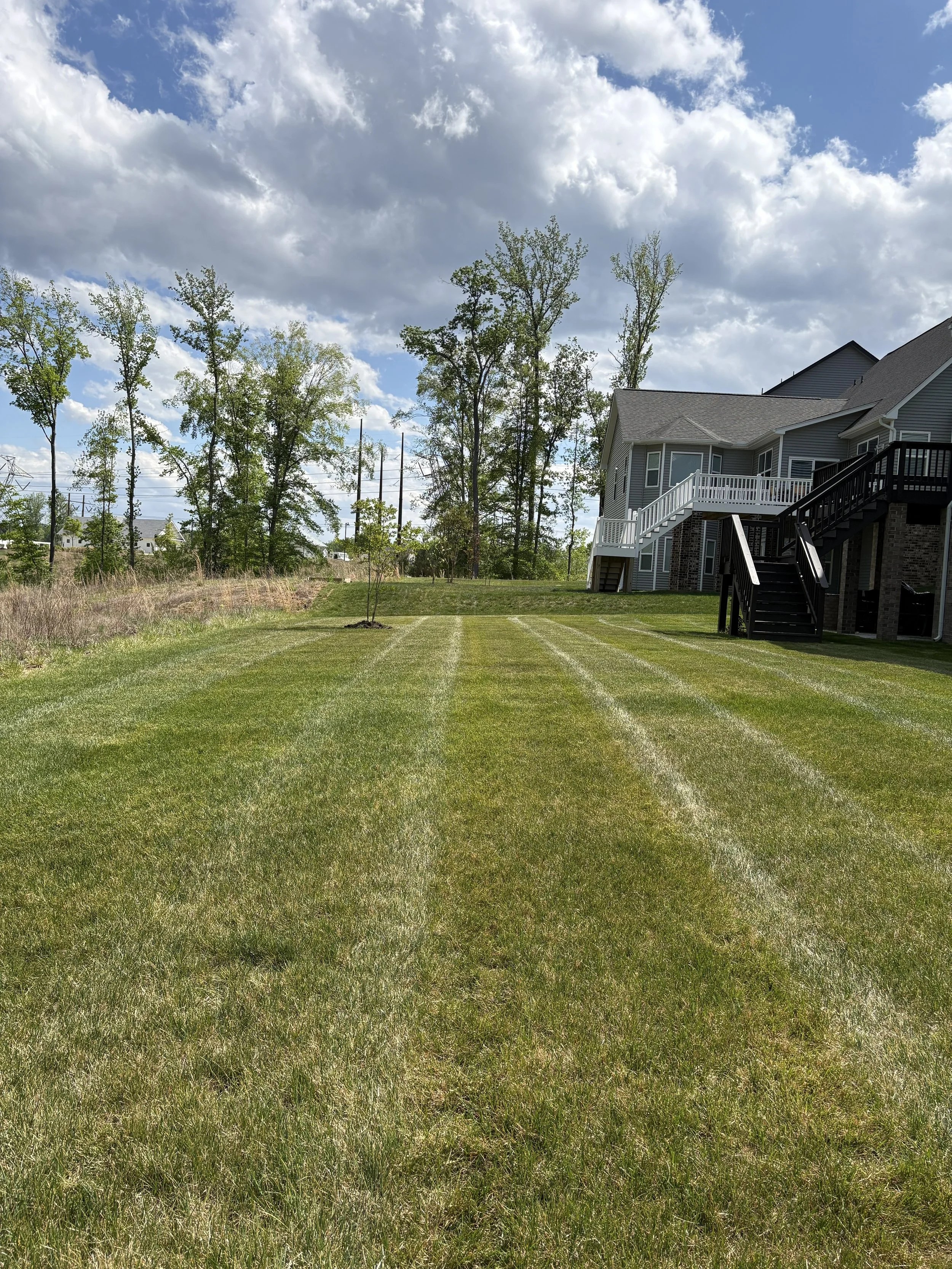
What Happens When You Violate the One-Third Rule
When you cut more than a third of the blade at once, the grass plant goes into a kind of shock. Here's why: the leaf blade is the plant's primary photosynthesis engine — it's how the grass produces the energy it needs to grow, maintain its roots, and recover from stress. Removing too much of it at once cuts off that energy supply dramatically and all at once.
The immediate visible effect is browning or yellowing at the tips — sometimes called scalping. But the longer-term effect is more significant: the plant diverts energy from root development to rebuilding leaf mass, which means shallower roots, reduced drought tolerance, and increased vulnerability to disease and weeds.
In practical terms, a lawn that regularly gets cut too aggressively will look stressed in summer, struggle to recover from dry spells, and be harder to maintain over time.
Why This Happens More Than You'd Think
The most common scenario where the one-third rule gets violated: a homeowner skips a week (or two, or three) and then cuts the lawn way down to get it back to a normal height in one pass. This is exactly the wrong approach.
If your lawn has gotten long — say, five or six inches — and you want it back at three inches, you need to take it down in stages. Cut it to four and a half inches first. Wait a few days or a week. Then cut to three and a half. Then to three. It takes a little longer, but the lawn stays healthy throughout.
The same principle applies after a rainy stretch, a vacation, or any time the lawn gets ahead of the schedule.
The One-Third Rule and Mowing Frequency
Here's where it connects to how often you should mow: during peak growing season in spring — April and May in central Virginia — tall fescue can grow an inch or more per week. If you're maintaining at three inches and cutting at four inches, you need to mow at least weekly to stay within the one-third guideline.
When growth slows down in summer heat or late fall, you can stretch the interval — but only because the grass isn't growing as fast, not because the rule has changed. The rule always applies. The schedule just adjusts to meet it.
How We Apply This on Every Yard
For every lawn we maintain across Glen Allen, Short Pump, Twin Hickory, and Wyndham, we're tracking growth rate and adjusting accordingly. We mow more frequently during growth flushes and ease up when growth slows. We never scalp, never rush, and never take down more than a third at a pass.
It sounds like a small thing. But over the course of a season, lawns maintained this way are visibly healthier, thicker, and more resilient than ones that aren't. The one-third rule is one of those fundamentals that separates good lawn care from great lawn care.
If you want your lawn on a professional schedule this spring, we still have a few spots. Call 804-572-9488.
About the Author
Matt Brown is the owner of ELM Lawn Care, a residential lawn care company serving Glen Allen, Short Pump, Twin Hickory, and Wyndham, VA. Matt started ELM with a simple goal: deliver consistent, professional lawn maintenance that homeowners can actually count on. When he's not on the mower, he's usually spending time with his family or planning the next season. ELM Lawn Care is licensed and insured — call 804-572-9488 to get on the schedule.