

Keeping Your Lawn Alive in the Virginia Summer Heat
If you've stepped outside this week in Glen Allen, you already know — this is the kind of summer heat that puts lawns to the test. After a stretch of temperatures pushing into the mid-to-upper 90s with heat indexes well into the 100s, local lawns are under serious stress right now. July in central Virginia is the hardest month on a lawn. Temperatures sit in the 90s for stretches at a time, rainfall becomes unpredictable, and cool-season grasses are operating well outside their comfort zone. This is the month when a lot of lawns hit a wall — and when the decisions made in spring either pay off or show their weaknesses.
We've been doing this long enough to know what works and what doesn't in July. Here's the honest guide to keeping your lawn alive through the worst of the Virginia summer.
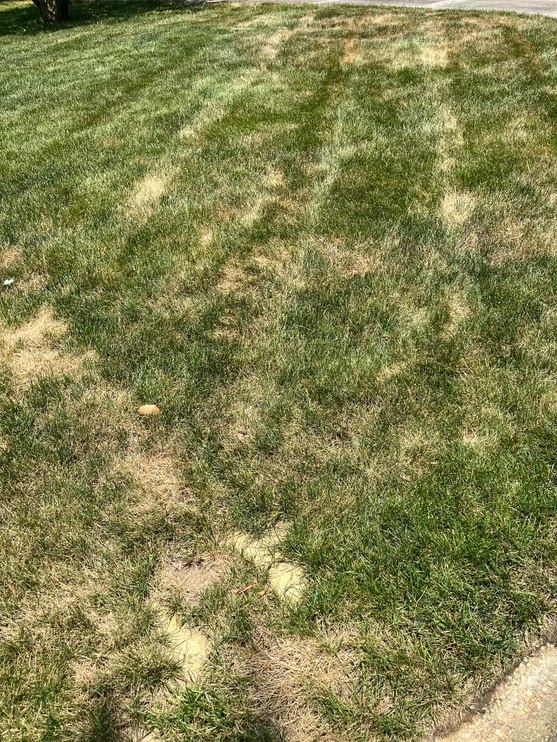
A typical Glen Allen lawn under July heat stress — dry patches and all.
Accept That July Is a Survival Month
The first thing to understand about July lawn care in Virginia is that your expectations need to shift. You are not going to make your lawn look better than it did in May. The goal is to hold what you have and come out of summer in good enough shape to take advantage of the fall recovery window.
Tall fescue, which covers most residential lawns in the Glen Allen area, is built for cool weather. In July it's stressed. The plants are working hard just to stay alive, and any extra stress you add — unnecessary fertilization, incorrect mowing, inconsistent watering — is working against you.
The lawns that sail through July are the ones where nothing dramatic happens. Consistent care, appropriate mowing heights, and smart watering. That's the whole game.
Mowing in July: Keep It High and Sharp
If there's one thing I'd tell every homeowner in Glen Allen and Short Pump about July mowing, it's this: keep the deck up. Three and a half to four inches. No exceptions.
Tall grass in summer serves several purposes. It shades the soil, keeping ground temperatures lower and reducing moisture evaporation. It gives the grass plant more leaf area to support photosynthesis, which means better stress tolerance. And it helps crowd out weeds, which are perfectly happy in the heat that cool-season grasses are struggling through.
With highs still expected to stay in the upper 80s and low 90s next week, resist the urge to cut short. This is not the time to go low.
Sharp blades matter in July more than any other month. Dull mower blades tear grass instead of cutting it cleanly, leaving ragged edges that lose moisture quickly and are more susceptible to disease. If you haven't sharpened your blades this season, July is a good time to do it.
Mow in the early morning when possible, and avoid mowing during the hottest part of the day. Heat-stressed grass doesn't recover from the additional stress of midday mowing as well as it would in cooler conditions.
Watering in July: Deep Roots Win
The lawns that handle July best are the ones with deep root systems — and deep root systems are built through proper watering habits established in spring and early summer. If you've been watering deeply and infrequently all season, your grass is positioned to handle dry stretches better than a lawn that's been watered lightly every day.
In July, aim for one to one and a half inches of water per week, applied in early morning sessions. Watering at night creates conditions for fungal disease; watering in the afternoon loses too much to evaporation. Morning is the right time.
A few days of rain in the forecast might feel like relief — and it is — but don't be fooled into thinking the hard part is over. A brief summer storm doesn't undo the stress of a prolonged heat event. Shallow rainfall can actually encourage shallow root growth over time, leaving your lawn more vulnerable the next time temperatures spike. Deep, infrequent watering is still the goal even when the skies cooperate.
If your area is under watering restrictions or if you can't keep up with full irrigation, consider letting the lawn go fully dormant rather than trying to maintain it with insufficient water. A dormant lawn is stable. A chronically under-watered lawn is in constant stress and more vulnerable to disease and thinning.
Leave the Fertilizer Alone
July is not a time to fertilize cool-season lawns. Full stop. Applying nitrogen to a heat-stressed lawn pushes growth the plant cannot sustain, increases water demand, and raises the risk of fertilizer burn on dry or drought-stressed turf.
If you feel like your lawn needs something in July, a light application of iron can help maintain color without pushing growth. But even that should be done carefully and only if the lawn is getting adequate water.
The next fertilizer window for Virginia lawns is September, when cooler temperatures and fall rains create the right conditions for a recovery feeding. That's when the work happens. July is for holding the line.
Watch for Disease
Heat, humidity, and the combination of stressed grass and inconsistent moisture creates ideal conditions for lawn disease in July. Brown patch is the most common one in central Virginia — it shows up as circular brown areas that can spread quickly, especially in lawns that are being overwatered or that have poor air circulation.
If you see circular patches spreading in your lawn in July, don't assume it's drought stress. Drought stress tends to be more uniform across the lawn or concentrated in sunny, exposed areas. Brown patch has a distinct circular pattern with a darker outer ring. If you're unsure what you're looking at, it's worth getting a second opinion before you start watering more — that can actually make fungal disease worse.
The Light at the End of the Tunnel
August brings some relief, and September is when everything turns around for cool-season lawns in Virginia. The heat breaks, fall rains arrive, and grass that looked like it was barely holding on in July starts recovering fast. That fall recovery window is when you can make real improvements — overseeding thin areas, aerating compacted soil, applying fall fertilizer.
But getting to September in decent shape starts with how you treat the lawn in July. Hold the line, keep the deck up, water smart, and leave the fertilizer in the bag. Your lawn will thank you in September.
If you've got questions about your lawn this summer, we're always glad to help. ELM Lawn Care serves Glen Allen, Short Pump, Twin Hickory, and Wyndham. Give us a call at 804-572-9488.
About the Author
Matt Brown is the owner of ELM Lawn Care, a residential lawn care company serving Glen Allen, Short Pump, Twin Hickory, and Wyndham, VA. Matt started ELM with a simple goal: deliver consistent, professional lawn maintenance that homeowners can actually count on. When he's not on the mower, he's usually spending time with his family or planning the next season. ELM Lawn Care is licensed and insured — call 804-572-9488 to get on the schedule.